How to Teach Subordinating Conjunctions in Writing (With Easy Examples and Activities)
Most importantly, subordinating conjunctions help students move beyond short, repetitive sentences and begin creating writing that sounds more connected and engaging.
In VCOP, subordinating conjunctions are powerful connectives that help writers create flow and strengthen their voice.
We’ve all stood in front of a classroom reading a piece of student writing that goes something like this: “The dragon woke up. It was mad. It breathed fire. The knight ran away.”
The sentences are grammatically correct, but the rhythm is entirely flat. The culprit? A heavy reliance on simple sentences.
If you want your students to instantly inject maturity, flow, and complex reasoning into their writing, you don’t need a dry 40-minute grammar worksheet. You just need to introduce them to Connie Connective’s ultimate upgrade toolkit: Subordinating Conjunctions.
Subordinating conjunctions are one of the easiest ways to help students instantly improve their writing.
They help students:
- join ideas together
- create smoother sentence flow
- explain their thinking
- add detail and complexity
- sound more mature as writers
What Is a Subordinating Conjunction?
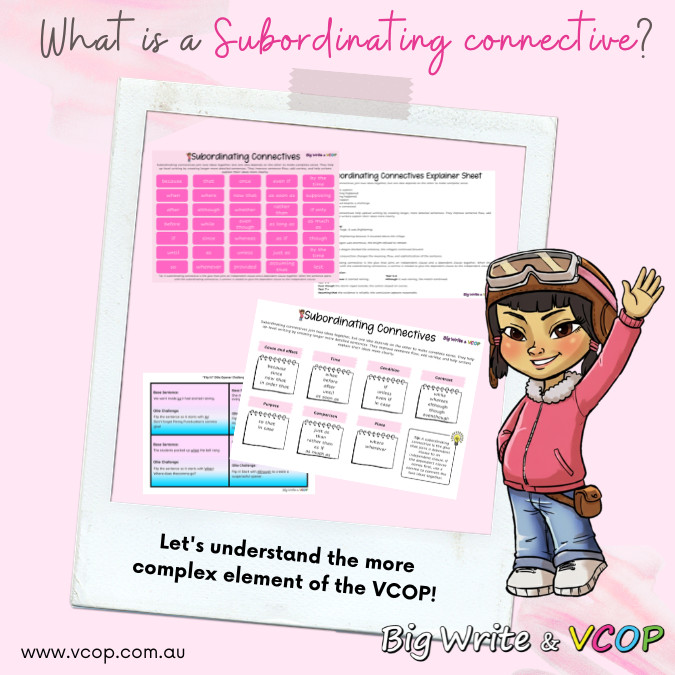
A subordinating conjunction is a word that joins two ideas together, but one idea depends on the other to make complete sense. It helps answer questions such as why, when, how, under what conditions, or to what extent something happens. This allows writers to create more detailed, connected, and sophisticated sentences that add clarity and depth to their writing.
For example:
I stayed inside because it was raining.
The word because joins the two ideas together:
- I stayed inside
- it was raining
The second idea explains why the first idea happened.
Common Subordinating Conjunctions
Instead of teaching them as one giant list, it is often easier for students to learn subordinating conjunctions in groups based on their purpose.
Time
These conjunctions show when something happens.
“After the bell rang, the students rushed outside.”
- when
- before
- after
- while
- until
- whenever
Examples
- We packed up before the storm arrived.
- I smiled when I saw my friend.
- After the bell rang, the students rushed outside.
Cause and Effect
These conjunctions explain why something happens.
“We practised every day so that we could improve.”
- because
- since
- so that
- in order that
- as
Examples
- She wore a jacket because it was cold.
- We practised every day so that we could improve.
- Since it was raining, sport was cancelled.
Condition
These conjunctions show that something will happen only if something else happens.
“You can play outside if you finish your homework.”
- if
- unless
- even if
- in case
Examples
- You can play outside if you finish your homework.
- I will help unless you want to do it yourself.
- Take an umbrella in case it rains.
Contrast
These conjunctions show differences between ideas.
“Although he was exhausted, the runner pushed past the finish line.”
- although
- even though
- whereas
- while
Examples
- Although he was tired, he kept running.
- Mia loves swimming, whereas Ava prefers dancing.
- Even though it was difficult, the team never gave up.
Simple Sentences vs Up-levelled Sentences
One of the best ways to teach subordinating conjunctions is through sentence up-levelling.
Students quickly see how conjunctions improve flow and make writing more interesting.
| Basic Sentence | Up-levelled Sentence |
| I was tired. I finished my work. | Although I was tired, I finished my work. |
| It had started raining. We went inside. | We went inside as it had started raining. |
| The bell rang. The students packed up. | When the bell rang, the students packed up. |
| She practised every day. She improved. | She improved because she practised every day. |
This helps students understand that conjunctions are not “extra grammar”. They are tools authors use to connect ideas clearly.
Why Subordinating Conjunctions Matter in VCOP
In VCOP, subordinating conjunctions sit within the Connectives banner.
They help students:
- link ideas smoothly
- avoid repetitive sentence structures
- improve sentence fluency
- strengthen openers
- sound more mature as writers
For example:
Instead of: The dragon was huge. It was frightening.
Students can uplevel to: The dragon was frightening as it towered above the village.
Or: Although the dragon was enormous, the knight refused to run away.
These conjunctions instantly improve the rhythm and quality of writing. Teaching students that they can move these clauses around builds incredible structural flexibility and dynamic reader engagement.
Common Student Mistakes
1. Overusing “because”
Students rely heavily on because.
Encourage students to experiment with:
- although
- while
- since
- unless
- after
- whenever
- as
This creates more sentence variety.
2. Writing Sentence Fragments
Incorrect: Because it was raining.
This is not a complete sentence because the reader is left waiting for more information. Because it is raining, what? What happened?
Correct: Because it was raining, we stayed inside.
3. Forgetting Commas
When a subordinating conjunction starts the sentence, students may need a comma to glue the two clauses together. If the dependent clause follows the independent clause, then the connective is the glue and no comma is needed.
Example: Although it was late, we continued working.
However: We continued working although it was late.
Students do not need to memorise complicated grammar rules at first. Reading the sentence aloud often helps them hear where a pause naturally occurs.
Easy Classroom Activities for Teaching Subordinating Conjunctions
Sentence Up-levelling Challenge
Give students two short sentences and ask them to combine them using a subordinating conjunction.
Example:
- The sun disappeared.
- The temperature dropped.
Possible answer: When the sun disappeared, the temperature dropped.
Or: The temperature dropped as the sun dissappeared.
To help you, use the
VCOP Warm-Up
Display a boring sentence such as:
The dog barked.
Challenge students to improve it using a subordinating conjunction.
Examples:
- The dog barked because it heard a strange noise.
- Although the dog barked loudly, nobody woke up.
- When the dog barked, the baby began crying.
To help you, have a look at the resource: Up-Level These Sentences With Connie which looks at both subordinating and coordinating connectives. You may like to look at both, or break it down into categories.
Conjunction Hunt
During reading time, students search for subordinating conjunctions in books, articles, or mentor texts.
Challenge them to identify:
- what the conjunction is doing
- which ideas it connects
- whether it shows time, cause, condition, or contrast
Oral Rehearsal Game
Give students a conjunction and ask them to orally create a sentence.
Example prompts:
- although
- because
- whenever
- unless
This builds confidence before writing.
Suggested Subordinating Conjunction Progression
Foundation–Year 2
Focus on:
- because
- when
- after
- before
- if
Students should orally practise combining ideas before writing independently.
Years 3–4
Introduce:
- although
- since
- while
- unless
- whenever
Focus on sentence variety and improving flow.
Years 5–6 (and beyond)
Encourage students to:
- vary conjunctions deliberately to improve sentence fluency and avoid repetition
- manipulate sentence structure for effect and control
- create sophisticated sentence openers that engage the reader
- use conjunctions to build tension, contrast, emotion, and author voice
- experiment with moving subordinate clauses to different parts of the sentence
- select conjunctions that best match the purpose and tone of the writing
Example subordinating conjunctions students may begin using:
- although
- even though
- whereas
- whenever
- unless
- since
- while
- provided that
- as though
- in order that
- despite the fact that
- as soon as
- rather than
Example Sentences
Although the pathway was dark and narrow, the explorers continued deeper into the cave.
Whenever the thunder cracked overhead, the little dog trembled beneath the table.
Unless we worked together, the raft would never survive the stormy river.
While the audience laughed loudly, the nervous actor forgot his lines.
Even though the storm hammered against the windows, the old house remained silent.
Final Thoughts
Subordinating conjunctions are far more than grammar terms students memorise for a worksheet.
They are powerful writing tools that help students:
- connect ideas
- explain their thinking
- improve sentence fluency
- strengthen writer’s voice
- create more engaging writing
When taught through oral language, sentence uplevelling, and authentic writing tasks, subordinating conjunctions become meaningful and immediately transferable into student writing.
The goal is not simply to identify conjunctions. The goal is to help students use them naturally to become stronger, more confident writers.
However, they are by far the hardest of the VCOP elements for the students to develop maturity in. Try supporting students by introducing them to one of the Subordinating Connectives support mats. If they find it a useful reference, add it to their personal VCOP writing support folder.
Try This VCOP Challenge
Can you improve this sentence using a subordinating conjunction?
The boy ran home. It started raining.
Possible answers:
- The boy ran home because it started raining.
- When it started raining, the boy ran home.
- Although it started raining, the boy continued running home.
How many different ways can your students improve it?